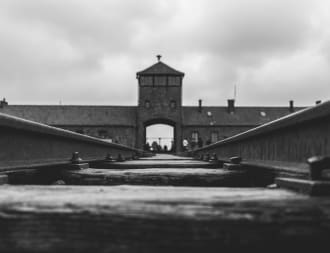
Pay respects at the largest Nazi concentration camp memorial
Visit the Warsaw Uprising Museum in Poland, dedicated to the 1944 Warsaw Uprising against Nazi occupation, featuring historical exhibits and artifacts
Explore D-Day landing sites and WWII memorials
Visit Westerplatte, the site of the first battle of World War II in Poland, known for its historical significance and monuments.
Three timelines converge on the beach evacuation of 1940, almost without dialogue.
The Omaha Beach landing that changed how war is filmed.
A boy in Hiroshima on 6 August 1945, drawn by a survivor; the manga on the bomb.
The Peace Park and the hypocentre, plus Dejima, the island where Japan traded with the world for 200 years.
Town beneath an active volcano.
Marcel Ophuls spends four and a half hours on the Butcher of Lyon and the people who protected him.
Hitler told through Goethe’s Reynard the Fox, in woodcuts and archive, narrated by Marlene Dietrich.
The ten thousand children Britain took in before the war, told by the children themselves at eighty.
John Ford filmed the battle from the roof of a power station and was wounded doing it; eighteen minutes of 16mm colour.
The people who knew her and hid her, including Miep Gies, filmed while they were still alive to speak.
The displaced-persons camps between 1945 and 1948, and the founding of Israel seen from inside them.
Five Hungarian Jews return to the places they were deported from in 1944; Spielberg’s Shoah Foundation.
The Simon Wiesenthal Center’s Holocaust documentary, narrated by Orson Welles and Elizabeth Taylor.
Nine and a half hours of witnesses, no archive footage; Lanzmann's Holocaust.
Thirty-two minutes on Auschwitz made in 1956; Resnais' film every French school shows.
Gary Oldman as Churchill in May 1940, and the speech in the Underground.
Hitler's last twelve days in the bunker, with Bruno Ganz; the meme and the masterpiece.
The Air Corps officers who believed precision bombing could win a war humanely, and Curtis LeMay burning Tokyo instead.
Spiegelman's father in Auschwitz, Jews as mice and Nazis as cats; the only comic with a Pulitzer.
John Hersey follows six survivors through the day of the bomb; the New Yorker gave it a whole issue.
Fourteen million killed between Hitler and Stalin in Poland, Ukraine and Belarus; Snyder's map of the killing.
Shirer, who was there, on Germany from 1933 to 1945 in 1,200 pages.
A man learns he came to Wales on the Kindertransport and follows the trail back; Sebald with photographs.
Anne Frank in the Amsterdam annex from 1942 to 1944.
Elie Wiesel at fifteen in Auschwitz and Buchenwald; a hundred pages that changed how the Holocaust is written.
The gateway wargame: the whole of the Second World War on one board.
Infobox



/pic42246.jpg?w=330)


